
Blog
The Sewing Circle That Decided to Become a Business
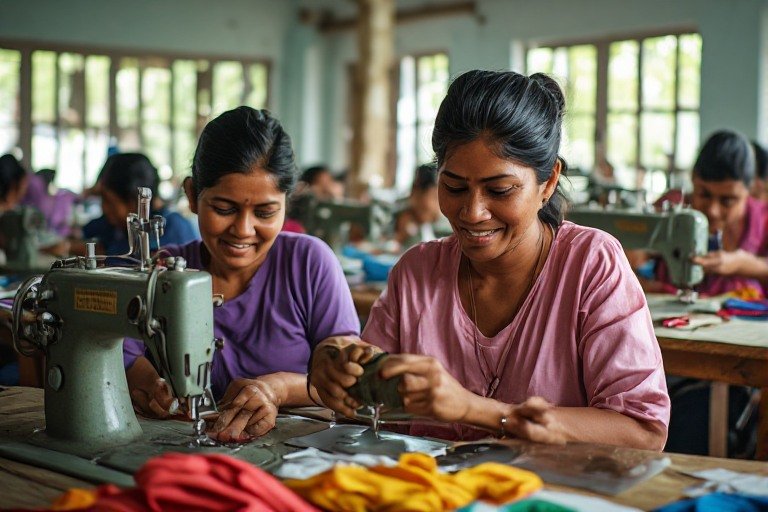
The room smells of machine oil and strong tea. Ten borrowed sewing machines clatter along two long tables, fabric scraps drift like confetti, and in the corner a ledger records every rupee in or out. Twelve women. One enormous decision. They are not a charity project anymore. They are a business.
How a circle becomes a company
It started, like most good things, with mending. Two years ago a handful of neighbours in Kandy began meeting weekly to sew school uniform repairs and share patterns. Our enterprise team noticed the skill level, offered a cutting techniques course, and watched the group finish every exercise early and ask for harder ones. Ambition announced itself clearly, so we stopped offering charity and started offering structure.
Over four months the group did the unglamorous work that separates hobbies from livelihoods. They registered as a society, opened a bank account requiring two signatures, elected a chair, a treasurer and a quality controller, and wrote simple rules. Late without notice twice and you sit out a week. Short measure on fabric and you replace it. Quality failures get unpicked on your own time. The rulebook fits on one page and is enforced without fear or favour, mostly by the treasurer, who misses nothing.
We invested where investment multiplies. Essential capital for twelve new machines of their own, bulk fabric at wholesale rates, a professional trainer for eight weeks on finishing and consistency, and help designing proper packaging. Total investment came to just under nine lakhs. Every rupee is recorded as a recoverable enterprise loan, repayable from profits over three years, because a gift creates gratitude while a loan creates ownership.
What they make and who buys it
The anchor product is washable reusable sanitary pads in day and night sizes, sold in sealed packs of six with instruction cards in all three languages. Schools buy them for student welfare programmes, including ours. Pharmacies in Kandy town stock them on consignment. Individual customers order through a simple phone list managed by the group’s youngest member, who at nineteen runs the order book, the delivery schedule and the group’s social media with terrifying efficiency.
The second line is household linen. Tablecloths, cushion covers and curtaining in bright prints, sold at weekend fairs and through two gift shops. Margins are better than pads but orders are seasonal, so the group balances the two lines deliberately. Pads pay the rent every month. Linen pays the bonuses at festival time. This is business thinking, learned fast and applied daily.
The maker group at formation
| Product | Buyers | Role in income |
|---|---|---|
| Reusable sanitary pads | Schools, pharmacies, phone orders | Steady monthly base |
| Household linen | Fairs, gift shops, festival orders | Seasonal bonus income |
The trainer who changed everything
Ask the group what made the difference and all twelve point at the trainer, a retired garment factory supervisor named Mrs. Jayasuriya, who inspected their first batch, held up a seam, and asked whether they would pay money for that. The silence, members recall, could be heard. Then she taught them to sew it properly, and eight weeks later their finishing passed an inspection from a Colombo boutique buyer without a single rejection.
Mrs. Jayasuriya’s rules hang on the workshop wall. Measure twice. Unpick cheerfully. The customer cannot see your effort, only your stitching. New members copy them into their notebooks on day one. Quality, it turns out, is a culture before it is a skill, and cultures need founders. The group found theirs.
Why this is Resources For All
Our enterprise philosophy has a simple test. If we left tomorrow, would the income continue. A food parcel fails that test by design, which is why parcels are for emergencies and stabilisation, never for building futures. A maker group passes it, because the machines, the skills, the customers and the ledger all belong to the members.
This is the collaboration our November story will later describe in full flower. But every flower was once a rented room with borrowed machines and twelve women daring to sign a bank form. Remember this post when you read that one. Beginnings matter, and this one smelled of machine oil and tea.
The order book and honest pricing
The group’s order book is a thick volume that lives with the youngest member, and it is worth describing, because it shows how seriously twelve beginners take business. Every order gets a page. Customer name, item, quantity, fabric cost, labour hours at the agreed rate, delivery date and deposit. Completed orders are ticked in green. Late ones, rare now, are marked in red with the reason written plainly beside them.
Pricing policy hangs above the cutting table. Labour charged fairly, never discounted to win work, because cheap prices teach customers the wrong lesson and starve the makers. Rush orders carry a stated surcharge. Friends and family pay full price, a rule that caused one memorable argument and now causes none. The treasurer reviews every page weekly, and the chair signs off monthly. This is not paperwork for its own sake. It is the difference between a hobby with income and a business with a future.
Donors gave us machines. The trainer gave us standards. But the business belongs to us, and so does every stitch in it.
Group treasurer, Kandy maker group
Buy from makers
The group welcomes wholesale and retail orders for pads and linen through our enterprise desk. Schools and pharmacies get reliable supply with proper invoicing. Individuals can join the phone order list for home delivery in the Kandy area.
Write to info@cjfsrilanka.org with the subject Makers and we will connect you directly. When you buy from makers rather than receiving charity goods, you fund dignity at both ends, the maker’s and your own.