
Blog
Up in Hatton the Tailoring Machines Hum Past Five
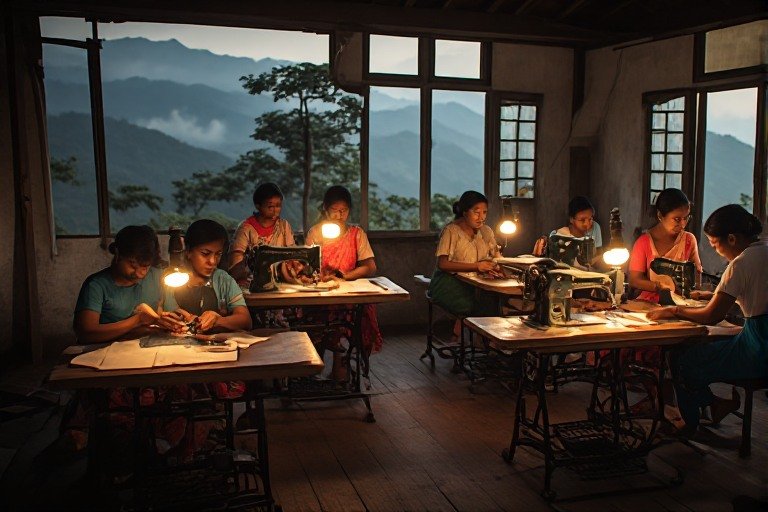
The plucking shift ends at four. By half past, the community hall above Hatton fills with women still in their estate jackets, swapping baskets for bobbins. Twenty students, eight machines, one instructor with infinite patience, and a shared understanding that this class is not a pastime. It is a second income being built stitch by stitch.
Why tailoring, why evenings, why here
Estate households live on wages that stop when the weather or the market turns. A second skill that earns from home changes the maths of a family, especially for women whose days already run from dawn to dusk. Tailoring fits because it needs little space, serves constant local demand for uniform hemming and blouse stitching, and scales from a corner of a line room to a real workshop.
Evenings are the only possible hour. Mornings belong to the fields, afternoons to cooking, cleaning and children. So classes run five to eight, three nights a week, with a creche corner where older daughters mind the little ones for a share of the class tea fund. Attendance has held above ninety percent for three months, a figure that tells you everything about motivation. Tired women do not attend classes they do not value.
The instructor, Mrs. Nadarajah, learned tailoring from her own mother, ran a successful home business for twenty years, and teaches with the brisk kindness of someone who has corrected ten thousand crooked seams. Her first rule is that nobody touches a customer’s garment until their practice seams pass inspection. Her second rule is that everyone passes eventually, because she has never met a student practice could not save.
The first paid order
In April the class took its first real order, forty school uniforms for a nearby estate school, with a five week deadline and a fixed price. The advanced students cut, the intermediates sewed straight seams, the beginners pressed, packed and learned. Quality checking fell to Mrs. Nadarajah, who rejected eleven pieces in week one, four in week two, and none at all after that.
Delivery came three days early. The principal paid on the spot, inspected every fortieth seam at random, and placed an order for seventy more for the next term, plus festival frocks for the school concert. The class profit, after fabric and a contribution to machine maintenance, came to just over one lakh rupees, divided by hours worked. Every student earned her first tailoring income that month, and the hall celebrated with tea and an enormous cake that said, in slightly sliding icing, Class of 2026.
Hatton tailoring class, first term
- FebruaryEnrolment and machine basics
- MarchSeams, hems and inspection standards
- AprilFirst paid order, 40 uniforms
- MaySecond order, 70 uniforms plus frocks
| Measure | Result |
|---|---|
| Students enrolled | 20 |
| Attendance rate | Above 90 percent |
| First order value earned | About 1 lakh rupees profit |
| Repeat order secured | 70 uniforms plus concert frocks |
What the income means at home
Ask the students what the money bought and the answers are gloriously ordinary. School shoes without holes. A gas cylinder so cooking no longer depends on firewood alone. A savings book with the first entries in a woman’s own name. One student paid off the shop credit that had hung over her family for a year, and describes the feeling as lighter than the day her daughter was born, which her daughter pretends not to mind.
The less visible gains matter more. Husbands who now ask about the class schedule. Daughters who announce they will learn too. A line room neighbour who mocked the idea in February and enrolled in May, pretending she had always believed. Dignity compounds quietly, and its interest rate beats any bank.
The plan from here
The class graduates its first cohort in August with certificates, starter kits of scissors, tapes and threads, and guaranteed piece work from the group’s growing order book. Ten new beginners join in September. Three advanced graduates will train as assistant instructors, earning while they learn to teach, because the best way to keep a skill in the hills is to grow teachers from it.
The creche corner and the tea fund
Every evening class needs somewhere for the little ones, and ours runs on an elegant economy. Older daughters mind the small children in the creche corner for a share of the class tea fund, earning while learning responsibility. The corner holds mats, picture books from our library programme and a strict rule that crying babies go straight to mothers, no waiting, no embarrassment.
The tea fund itself is a marvel of micro finance. Each student contributes twenty rupees a week. The fund buys tea, sugar and milk in bulk, and the surplus, carefully recorded by a rotating student treasurer, paid for the creche mats and now saves toward a second fan for the hall. When the class treasurer presented the tea fund accounts alongside the uniform order accounts, the whole room applauded. Small money, managed transparently, teaches the same lessons as large money.
My mother plucked tea. I pluck tea. My daughter will stitch blouses and choose. That is what these evenings are buying.
Evening class student, Hatton
Uniform orders from estate schools, blouse and alteration work from individuals, and festival season bulk orders are all welcome. Quality is inspected, deadlines are sacred, and the cake at delivery is optional but traditional. Write to info@cjfsrilanka.org with the subject Hatton tailoring, and Mrs. Nadarajah will inspect your enquiry with the same care she gives a seam.