
Blog
A Clinic Under a Tent and a Queue That Started at Dawn
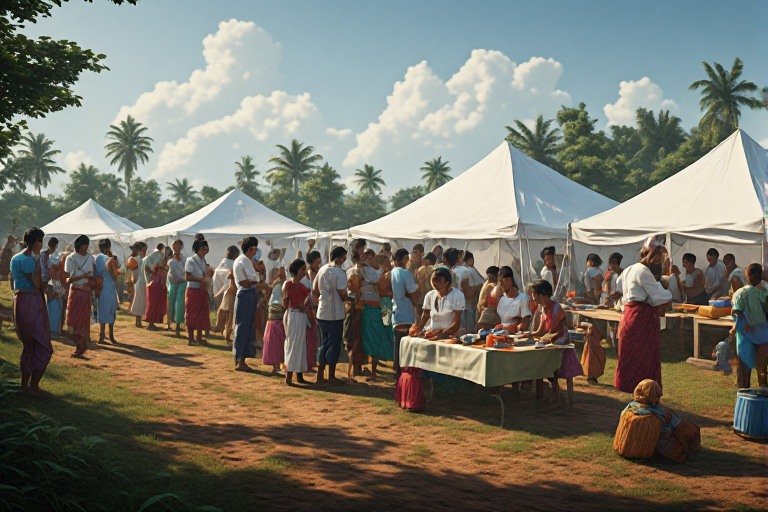
The queue started forming at half past five in the morning, an hour before our van even arrived. By the time the tents were up and the tables arranged, two hundred people were waiting patiently in the school ground with their clinic books in plastic bags. Nobody complained. In villages far from the base hospital, a visiting clinic is an event worth waking for.
How a camp day runs
Months of preparation hide behind the apparent simplicity. Our health team visits the site twice beforehand, agrees the date with the village committee and the midwife, and sends word through temples, mosques, churches and the school. Registration tokens go out the evening before through village contacts, numbered and colour coded by family, so the morning queue has an order even before it forms.
Inside the tents, patients move through stations. Registration and history. Blood pressure and blood sugar. Doctor consultation. Eye testing and spectacles fitting. Pharmacy dispensing with careful explanation in the patient’s own language. Children get weighed and measured at a separate cheerful corner with crayons, because a health camp should not feel like a punishment for being small.
This March camp ran with two volunteer doctors, six nurses, one optometrist and twenty general volunteers managing queues, records and the endless tea supply. Two hundred and forty patients were seen in seven hours. Forty one were referred onward to the base hospital for conditions needing proper investigation, and our follow up team has already confirmed thirty four attended. The remaining seven get a second visit and, if needed, a volunteer escort. Referrals without follow up are just paper.
The spectacles miracle, repeated
Every camp has a moment that reminds you why spectacles matter more than their price suggests. This time it was a seventy year old grandmother who had not threaded a needle in three years and, with her new readers perched on her nose, threaded one on the first try to applause from the entire eye tent. She then examined the optometrist’s face closely and announced he looked younger than his voice, which the whole queue enjoyed enormously.
One hundred and ten pairs were fitted at this camp alone, each tested at three distances and logged with the patient’s name and village. Broken or lost pairs within six months are replaced free, because a promise that expires is not a promise. Our total across all camps now stands at over five hundred pairs, and the waiting list for the next camp already holds eighty names.
March health camp results
| Measure | Count |
|---|---|
| Patients registered and seen | 240 |
| Referred for hospital review | 41 |
| Referrals confirmed attended | 34 |
| Reading glasses fitted | 110 |
| Children weighed and measured | 63 |
What the records reveal
Camp records, anonymised and tallied each evening, paint a clear picture of rural health need. High blood pressure leads by far, often undiagnosed for years. Diabetes follows, then vision problems, then anaemia among young mothers. None of these require a teaching hospital to manage once found. They require finding, which is exactly what a tent in a school ground does.
We share these tallies with the district health office after every camp, and the relationship works well. Twice now our camps have caught tuberculosis suspects who were started on treatment within the week. Public health is a team sport and we are happy to play any position, including tent pegs and tea.
The volunteers who make it move
Medical volunteers give the expertise, but general volunteers give the camp its rhythm. Queue managers who know every family by sight. Scribes who write clearly enough for the pharmacy to read. Runners who ferry samples and files between tents. The tea team, whose work is officially classified as morale infrastructure and unofficially recognised as the reason doctors keep coming back.
Inside the pharmacy tent
The busiest tent is rarely the doctor’s. It is the pharmacy, where a volunteer pharmacist and two trained assistants dispense a month of meaning in small paper packets. Every medicine is explained in the patient’s own language, dose by dose, with the schedule written on the packet in large clear script. For patients who cannot read, the team draws suns and moons, morning and night, a system the nurses invented years ago and now teach at every camp.
Chronic patients get something extra, a return slip with the next camp date and their token number pre assigned, so continuity survives the six week gap. The pharmacy log records every dispensation, and the evening tally reconciles stock to the packet. On this March day the tent dispensed to two hundred and twelve patients without a single queue complaint, which the queue manager credits to the numbering system and the tea runners in equal measure.
People walk past a hospital for years because it feels far. Bring the clinic to their school ground and they will queue from dawn. Distance is measured in courage, not kilometres.
Volunteer doctor, March camp
Next camp dates
Health camps run every six to eight weeks through the year, rotating across our programme areas. The next two dates and locations are announced through village contacts and our volunteer channel two weeks ahead. Spectacle waiting list patients are seen first at each camp, so join the list early through your midwife or village contact.
Medical professionals who can spare a weekend, and non medical volunteers who can spare their legs and their smiles, write to volunteer@cjfsrilanka.org. The queue starts at dawn. We will save you a token.